In this article
- Key Takeaways
- What Are Google AI Overviews?
- Why Does Ranking in AI Overviews Matter for Your Business?
- How Does Google Choose Which Pages to Show in AI Overviews?
- How to Rank in Google AI Overviews: 8 Practical Steps
- What Does a Page That Gets Cited Look Like?
- How Can You Track Your AI Overview Performance?
- What Mistakes Stop Websites From Appearing in AI Overviews?
- Frequently Asked Questions
- Where Should You Start?
You type a question into Google and the first thing you see is not a list of websites anymore. It is a short summary written by Google’s AI, with a few source links beside it. If your business is not one of those sources, many people will never scroll far enough to find you.
So how do you rank in Google AI Overviews? Honestly, there is no secret trick. Google itself says normal SEO still applies. But there is a way of writing and structuring your pages that makes Google much more likely to pick you as a source, and most Indian websites are not doing it yet.
We have been testing this on client websites at Balhara Infotech for over a year. What you will read below is a mix of Google’s own guidance and what we have seen work for clinics, coaching centres, D2C brands and service businesses across Delhi NCR.
Key Takeaways
- AI Overviews pick sources from pages Google has already indexed and ranks. Basic SEO comes first.
- There is no special “AI schema” or secret tag. Google has confirmed this in its Search Central documentation.
- Pages that answer the question clearly in the first two or three sentences get cited far more often.
- Real experience, a named author and fresh updates help a lot, especially for health, money and legal topics.
- You can track results in Search Console, because AI Overview traffic is counted inside your normal Web search data.
What Are Google AI Overviews?
Google AI Overviews are AI generated summaries that appear at the top of some Google search results. They answer the search in a few lines and show links to the websites used as sources. Google shows them when a summary adds value beyond normal results, usually for detailed questions.
They are not a small experiment anymore. At Google I/O 2026, Google said AI Overviews had crossed 2.5 billion monthly users. In India, Google also offers AI Mode, a chat style version of Search. It launched for Indian users in English in July 2025 and added Hindi in September 2025.
People often mix these features up. Here is the simple difference:
- Featured snippet: one extract from one page, best for short factual questions.
- AI Overview: an AI summary above the results with several linked sources, best for detailed questions.
- AI Mode: a full conversation with follow ups and links inside the answer, best for complex research.
Why Does Ranking in AI Overviews Matter for Your Business?
It matters because people click normal results less when an AI Overview appears. A Pew Research Center study from July 2025 found users clicked a traditional result in 8% of visits with an AI summary, compared with 15% without one. Being cited inside the overview keeps you visible at the top.
Think about a dental clinic in Gurgaon. Someone searches “how long does a root canal take” and Google answers right there. The clinic whose page is cited gets its name seen by that patient, even if the patient does not click today. When they later search “root canal dentist Sector 84”, that name feels familiar.
Here is something we keep noticing in client reports. Simple “what is” traffic is falling for almost everyone. But the visitors who do click through from AI answers tend to be more serious, because they have already read the basics and want the next step.
How Does Google Choose Which Pages to Show in AI Overviews?
Google picks sources using its normal ranking and quality systems. It often runs several related searches in the background, which Google calls “query fan out”, and then picks pages that answer each part well. To be eligible at all, a page must be indexed and allowed to show a snippet in Google Search.
Fan out is the part most people miss. Say someone in Noida searches “best coaching centre for JEE near me with weekend batches”. Google may quietly look up fees, results, batch timings, faculty and reviews as separate questions. A page that covers all of these clearly has many more chances to be picked than a page that only says “We are the best coaching centre in Noida”.
How to Rank in Google AI Overviews: 8 Practical Steps
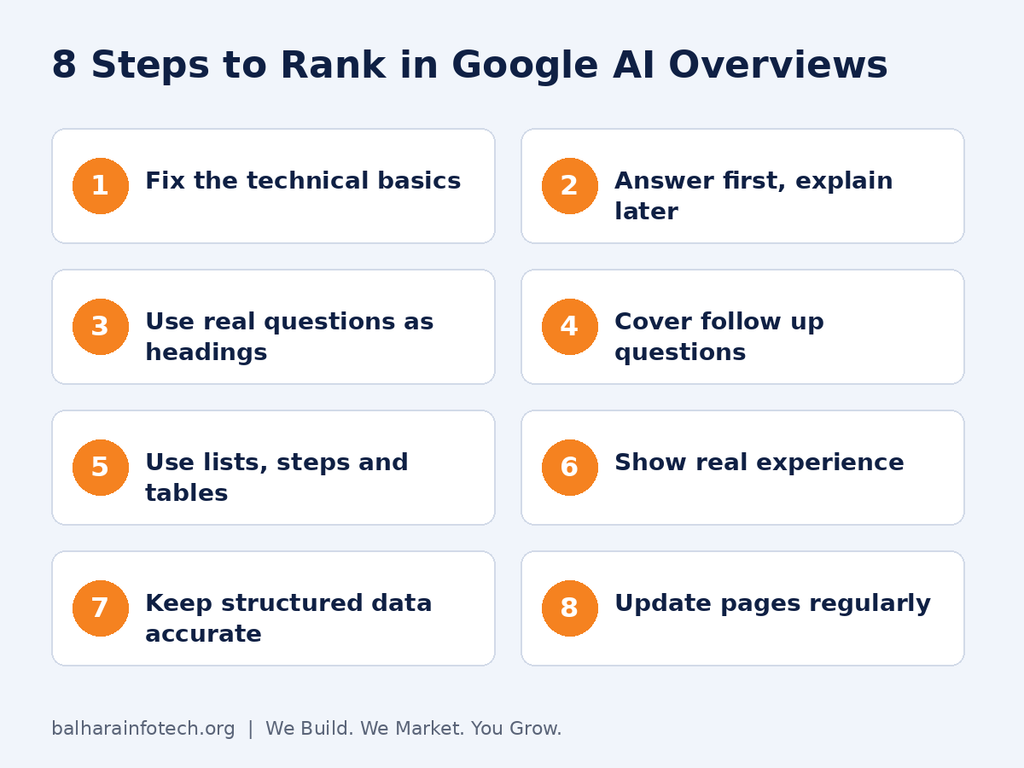
To rank in Google AI Overviews, get your page indexed and ranking, answer the main question in the first few lines, cover the follow up questions people ask, and show real experience. The eight steps below put this into practice, in the order we use with clients.
1. Fix the Technical Basics First
If Google cannot crawl and index your page, nothing else matters. Open Google Search Console, use the URL Inspection tool and confirm the page is indexed. Check that you have not added a nosnippet tag by mistake, because that stops your content from appearing in AI features.
Also check mobile speed. Most of your Indian visitors are on phones, often on patchy mobile data. A slow page will lose rankings long before it gets anywhere near an AI Overview.
2. Answer First, Explain Later
Put a clear answer of about 40 to 60 words straight under every main heading. Then add detail, examples and exceptions below it. Google lifts passages, not whole articles, so each answer should make sense even if someone reads only that paragraph.
A quick test we use: cover everything except the first paragraph under a heading. Does it still answer the question on its own? If not, rewrite it.
3. Write Headings as the Questions People Really Ask
Use the exact questions your customers type or say. You will find them in Google’s “People also ask” box, in the Queries report in Search Console and, best of all, in your own sales calls and WhatsApp chats.
Do not ignore Hinglish and Hindi. Many people in India search the way they talk, for example “SEO kitna time leta hai”. If your customers ask questions like that, write a page or section that answers them in the same language.
4. Cover the Follow Up Questions Too
After the main answer, think about what the reader will ask next. For a “cost of a website in India” page, that means timelines, hosting, maintenance, what affects price and what to avoid. Covering these in clear sections matches how query fan out works.
5. Use Lists, Steps and Tables
Numbered steps, short bullet lists and comparison tables are easy for Google to read and reuse. If you are explaining a process, number it. If you are comparing options, put them in a table. Keep each row and bullet short and specific.
6. Show Real Experience and Trust
Google’s quality systems look for E E A T, which stands for experience, expertise, authoritativeness and trust. In simple words: show that a real person who knows the subject wrote this. Add an author name and bio, real photos from your work, and details only someone who has done the job would know.
For local businesses, your Google Business Profile matters here too. Real reviews, correct address, clear services and regular updates all make Google more confident about who you are.
7. Keep Structured Data Accurate
Google says there is no special schema needed for AI Overviews. Still, normal structured data such as Article, FAQ, LocalBusiness and Product helps Google understand your page. The key rule from Google is that your structured data must match what is visible on the page.
8. Update Your Important Pages Regularly
Old prices, old screenshots and “best tools of 2023” lists send the wrong signal. Review your top pages every three to six months. Update facts, add new questions you have heard from customers, and change the “last updated” date only when you have genuinely updated the content.
What Does a Page That Gets Cited Look Like?
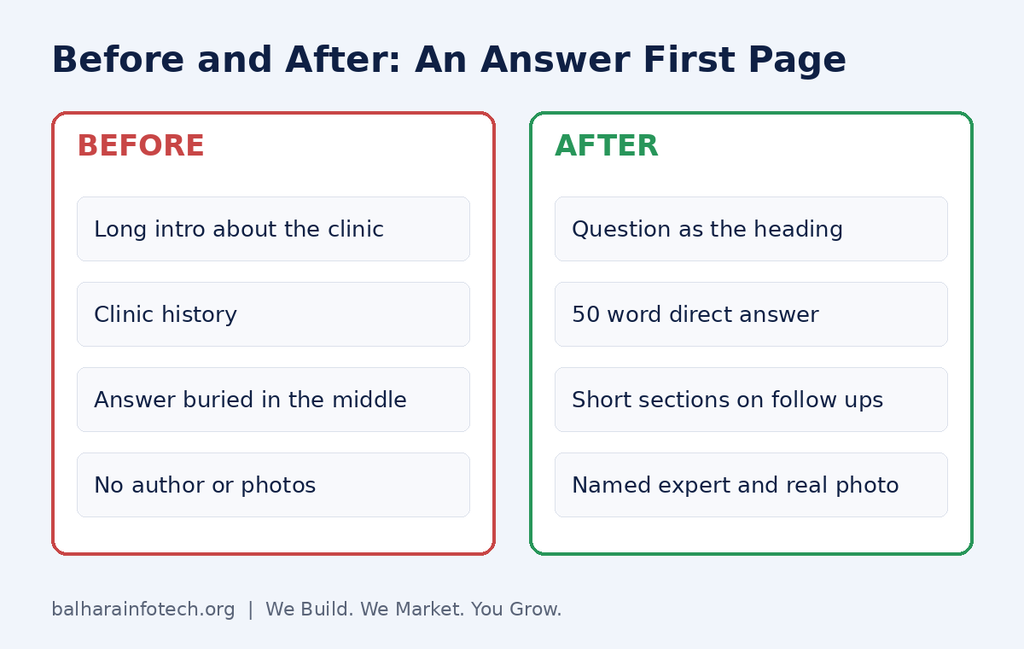
Let us take a physiotherapy clinic in Gurgaon that wants to show up for “how many physiotherapy sessions for knee pain”.
Before: The page starts with three paragraphs about the clinic’s history. The actual answer is buried in the middle, with no heading and no clear number.
After: The page opens with a heading that matches the question. Right below it, a 50 word answer explains that the number of sessions depends on the cause, and that the physiotherapist decides after an assessment. Then come short sections on what affects the number, what happens in each session, cost in Gurgaon and when to see a doctor instead. The physiotherapist’s name and qualifications sit at the top, with a real photo from the clinic.
Same clinic, same expertise. The second version is simply far easier for Google to understand and quote. In our experience, this kind of rewrite is the quickest win for most small business websites.
How Can You Track Your AI Overview Performance?
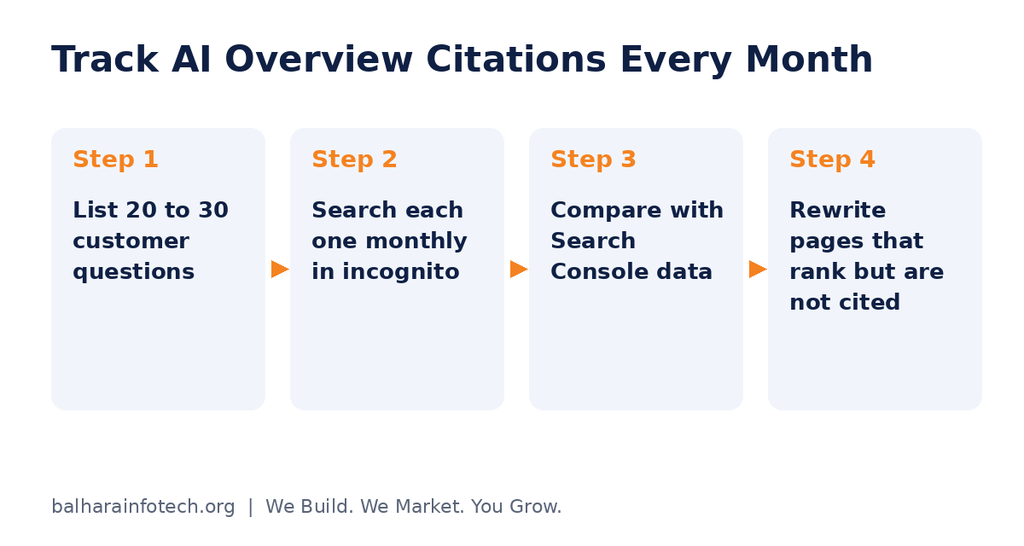
Google Search Console includes clicks and impressions from AI Overviews and AI Mode in your normal Performance report, under the Web search type. There is no separate AI filter yet, so track question style queries over time and check important searches manually to see whether your site is cited.
Here is a simple system that works:
- List 20 to 30 important questions your customers ask.
- Search each one in an incognito window every month and note whether an AI Overview appears and who is cited.
- Compare this with impressions and clicks for those queries in Search Console.
- Rewrite the pages that rank but are not cited, using the steps above.
This is part of the plain language monthly report we share with every Balhara Infotech client, so business owners can see exactly where they appear and what changed.
What Mistakes Stop Websites From Appearing in AI Overviews?
The most common mistakes are long introductions that hide the answer, thin pages with no real detail, blocked or unindexed pages, and content copied from other sites. Writing only for keywords instead of for people is another big one. Fix these and most websites see a clear difference.
A few others we see often:
- Blocking Google by accident with a nosnippet tag or a wrong robots.txt rule
- Publishing 50 similar AI written pages with no first hand insight
- Adding FAQ schema for questions that are not visible on the page
- Forgetting to update prices, dates and offers
Frequently Asked Questions
Can I pay Google to appear in AI Overviews?
No. You cannot pay to be cited as a source in an AI Overview. Ads may appear near some AI experiences, but organic citations are chosen by Google’s ranking systems. The only way in is useful, well structured content on a healthy website.
Do I need special schema to rank in Google AI Overviews?
No. Google has said there is no special structured data required for AI Overviews or AI Mode. Normal schema like Article, FAQ and LocalBusiness still helps Google understand your page, as long as it matches the content people can see.
How long does it take to appear in AI Overviews?
There is no fixed timeline. A page usually needs to be indexed and ranking well before it gets cited. For an existing page that already ranks, a good rewrite can show results within a few weeks. A brand new page on a new website usually takes longer.
Can a small local business appear in AI Overviews?
Yes. Local questions like “best time to visit a dentist for braces” or “documents needed for GST registration” often cite small, specialist websites. A clear answer from a real local expert can beat a big national brand with a generic page.
Will AI Overviews reduce my website traffic?
They can reduce clicks on simple information searches, because people get the answer on Google. But being cited keeps your brand visible, and visitors who do click are often closer to buying. Commercial and local searches still bring strong traffic for most businesses.
Does Hindi content appear in Google AI features?
Yes. Google’s AI features work in many languages, and AI Mode has supported Hindi since September 2025. If your customers search in Hindi or Hinglish, writing clear answers in that language gives you a real chance to be cited.
Can I stop my content from showing in AI Overviews?
Yes. You can use preview controls such as the nosnippet or max snippet robots rules. Keep in mind that these also limit how your page appears in normal search snippets, so most businesses are better off staying visible.
Where Should You Start?
Pick your five most important pages. Check that they are indexed, then rewrite the top of each page so it answers the main question in two or three clear sentences. That one change alone puts you ahead of most websites in your city.
If you would like a second pair of eyes, our team in Sector 84, Gurgaon will check your site for free. We will tell you which pages have a real chance of appearing in AI Overviews and what to fix first, in plain language. No lock in contracts, no jargon.
Get a free SEO audit and find out where your website stands in AI search today.